- 1. What Is Noni Leaf?
- 2. Noni Leaf vs. Noni Fruit: Why the Difference Matters
- 3. What Does the Research Actually Say About Noni Leaf and Skin?
- 3.1. Is Noni Leaf an Antioxidant?
- 3.2. Is Noni Leaf Anti-Inflammatory?
- 3.3. Is Noni Leaf Safe for Skin?
- 3.4. Can Noni Leaf Help With Redness From Sun Exposure?
- 4. What Is Noni Extract, and Why Does the Type Matter?
- 5. How Is Noni Used in Skincare?
- 6. Noni + CBD Skincare: What’s Known and What Isn’t
- 7. How Maui CBD Infusions Uses Hawaiian Noni Leaf
- 8. How Do You Safely Use a Noni Topical?
- 9. The Bottom Line
Noni fruit and noni leaf are often treated as the same ingredient, but they are not. They come from different parts of the plant, and the research behind them differs too. That distinction matters if you are considering a noni leaf skincare product, because the evidence behind one form cannot automatically be applied to the other.
Research on Morinda citrifolia has documented antioxidant and anti-inflammatory activity. One human trial tested noni leaf extract against UVB-induced redness, finding that treated skin required nearly 3.5 times as much UVB exposure to redden as untreated skin. That is a real result, but it involved a specific extract under specific conditions. It does not mean every product labeled “noni” offers the same effect.
This guide looks at what the science actually supports, so you can tell evidence-backed claims from marketing.
| Quick Answer: Is Noni Leaf Good for Skin? Some evidence supports noni leaf for skin, though it is narrower and more specific than the general ‘noni’ conversation online usually reflects. Laboratory and animal studies show noni leaf extract has antioxidant and anti-inflammatory activity, and small human studies found it well tolerated on skin with a possible effect on UV-related redness. It has not been shown to treat skin conditions, reverse aging, or replace sunscreen. |
Key Takeaways
|
What Is Noni Leaf?
Noni is the common name for Morinda citrifolia, a small tropical tree in the Rubiaceae family, native to Southeast Asia and the Pacific Islands. Across Polynesia and Hawaii, traditional use covers nearly every part of the plant:
- Fruit – eaten or juiced, the form most people know from health drinks
- Leaves – applied topically, historically used in the Marquesas Islands and Rotuma for skin inflammation and burns
- Bark and roots – used in various traditional preparations, less relevant to modern skincare
Most online content about “noni for skin” is actually about the fruit or its juice. Noni leaf is a separate part of the plant, with a smaller, more recent, and more skin-specific body of research behind it.
| So is noni leaf good for skin? Somewhat, and cautiously. There is real laboratory, animal, and limited human evidence pointing to antioxidant and anti-inflammatory activity, as well as small human studies on skin tolerance and UV-related redness. That’s more evidence than most botanical skincare ingredients can claim, but it stops well short of proof that noni leaf treats or reverses any skin condition. |
Noni Leaf vs. Noni Fruit: Why the Difference Matters
This is the distinction most noni content skips, and it’s the most important thing in this article. Leaf and fruit come from the same plant but contain different compounds, are used differently in traditional medicine, and have been studied through different types of research.
| Feature | Noni Leaf | Noni Fruit |
| Plant part | Leaves of Morinda citrifolia | Ripe fruit of Morinda citrifolia |
| Traditional use | Applied topically for wounds, burns, pain, and inflammation | Consumed as juice; used for digestion, joint discomfort, general wellness |
| Notable compounds | Flavonoids (rutin, quercetin, kaempferol), phenolics, tannins | Vitamin C, potassium, iridoids, scopoletin |
| Skincare research | Direct topical studies exist, including small human trials | Mostly extrapolated from internal-health (juice) research, not topical fruit studies |
| Evidence limitations | Human studies are small and not independently replicated at scale | Skin-specific evidence is thin; most fruit research concerns ingestion |
The takeaway: A study showing noni fruit juice supports antioxidant activity when consumed says very little about whether a noni leaf salve does anything for your skin. Related ingredient, separate evidence.
What Does the Research Actually Say About Noni Leaf and Skin?
Here’s what has actually been tested, broken down by evidence type.
Is Noni Leaf an Antioxidant?
Evidence level: laboratory and animal
A widely cited study on aqueous (water-based) noni leaf extract found:
- Measurable antioxidant activity in lab assays
- Reduced markers of oxidative stress in animal models
- Reduced pain-related behavior and leukocyte migration in rodents
What this supports: Noni leaf extract shows real antioxidant activity in controlled lab and animal settings.
What it doesn’t support: A guarantee that a noni leaf product visibly reduces oxidative skin damage in humans.
Is Noni Leaf Anti-Inflammatory?
Evidence level: laboratory (cell-based)
- A cell-culture study testing several Morinda citrifolia extracts found the seed extract was the most active anti-inflammatory agent, more effective than the leaf, fruit, or seed oil extracts tested alongside it
- The leaf extract still showed some inflammatory-marker reduction in this study, just less than the seed extract
- Separately, aqueous leaf extract reduced inflammatory swelling in rodent models
What this supports: Noni leaf has documented anti-inflammatory activity in cell and animal models, though the seed extract appears stronger in direct comparisons.
What it doesn’t support: Any claim that noni leaf treats an inflammatory skin condition in humans.
Is Noni Leaf Safe for Skin?
Evidence level: human
This is the strongest data point in the noni leaf research base:
- A repeat-insult patch test on 49 human volunteers tested a gel containing ethanol extract and pressed juice from noni leaves for allergenic potential
- No evidence of allergic or irritant reaction was found in a related skin-care regimen study
- Separately, a mouse and rabbit study found noni leaf extract caused negligible skin irritation on rabbit skin
What this supports: Real, human-tested reassurance that noni leaf extract is generally well tolerated.
What it doesn’t support: A guarantee of safety for every individual. People with plant or tree-nut allergies, or generally reactive skin, should still patch test.
Can Noni Leaf Help With Redness From Sun Exposure?
Evidence level: human, preliminary
A 2009 clinical trial found that noni leaf extract helped protect skin against UVB-induced erythema (redness)
This is a genuinely interesting result, but:
- It comes from one relatively small trial
- It has not been measured against SPF standards
- It should not be treated as sunscreen or sun protection
If you’re in the sun, sunscreen is still the tool actually designed and regulated for that job.
What Is Noni Extract, and Why Does the Type Matter?
“Noni extract” on an ingredient list isn’t a single standardized ingredient. Depending on how it’s made, it can mean:
- Fruit juice or puree, the most common form in noni health drinks
- Aqueous (water based) leaf extract, the form used in most of the leaf research above
- Ethanol or alcohol based extract pulls out a different compound mix than a water extract
- Oil infusions leaf or fruit steeped in a carrier oil, common among small batch producers
- Hydrosols steam distilled leaf water, chemically distinct from an oil infusion or alcohol extract
- Dried, powdered leaf or fruit used in teas and capsules
Why it matters: A study on an ethanol leaf extract doesn’t automatically tell you what a hydrosol or oil infusion will do, even though both can be labeled “noni.” When evaluating a noni skincare product, it’s worth checking whether the label specifies leaf, fruit, or extract type, rather than assuming all “noni” ingredients perform the same way.
How Is Noni Used in Skincare?
Common formats include:
- Salves and balms
- Oil-based infusions
- Creams and body butters
- Occasionally, hydrosol mists
Leaf-based noni tends to appear more often in small-batch, regional producers, particularly in Hawaii, where hand-harvesting leaf is part of the process. Fruit-based noni (extract or juice) is more common in mass-market skincare, largely because fruit is easier to source commercially at scale.
If you see “noni” or “Morinda citrifolia” on an ingredient list, it’s worth noticing whether it specifies leaf, fruit, or extract type. Many labels don’t, which is itself worth knowing: an unspecified “noni extract” could be any of the forms above, with any of the evidence (or lack of it) that comes with them.
Noni + CBD Skincare: What’s Known and What Isn’t
Topical CBD (cannabidiol, a non-intoxicating compound derived from hemp) has become a common skincare addition, generally marketed and studied for potential calming and skin-soothing properties. Research into topical cannabinoids on skin is still an active, evolving area, smaller and less established than the research on more traditional skincare ingredients.
Noni leaf, as covered above, has its own separate evidence: antioxidant and anti-inflammatory activity in lab and animal studies, plus limited human data on tolerance and UV-related redness.
That doesn’t make the combination a bad idea, it means:
- Each ingredient has been studied on its own merits
- A brand combining them is making a formulation choice grounded in complementary traditional and cosmetic roles
- The pairing hasn’t been clinically studied on its own, so it’s best understood as two well-researched ingredients used together rather than a tested combination.
How Maui CBD Infusions Uses Hawaiian Noni Leaf
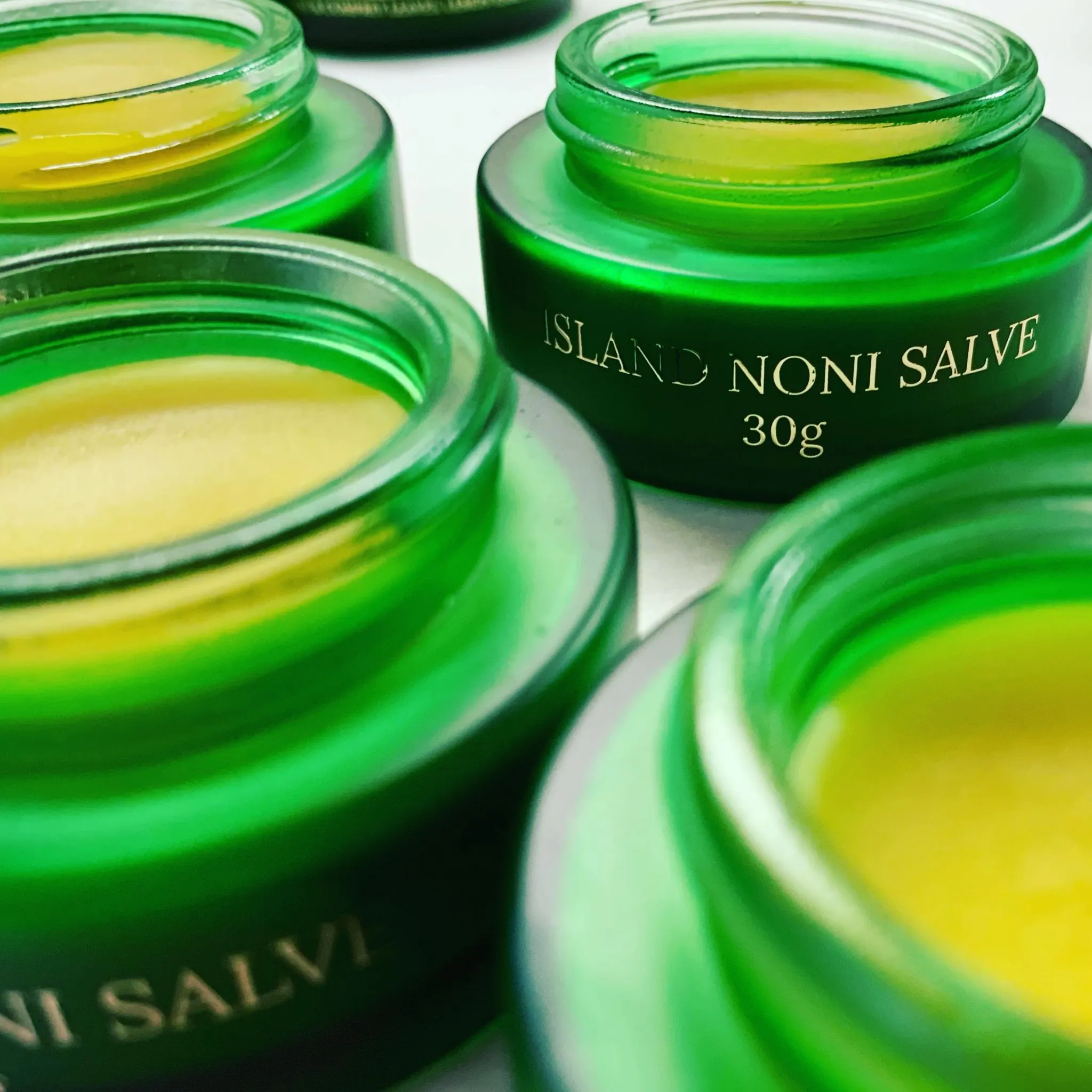
Maui CBD Infusions is based in Hawaii, and noni leaf is one of the botanicals it sources directly rather than buying as a pre-made commercial extract.
- The ingredient sourcing states noni leaf is gathered by hand, alongside other Maui-grown botanicals like tamanu (kamani) oil, macadamia butter, and locally sourced beeswax
- The origin story traces back to a family farm growing its own hemp on Maui, part of what shapes its hands-on approach to sourcing plant ingredients generally
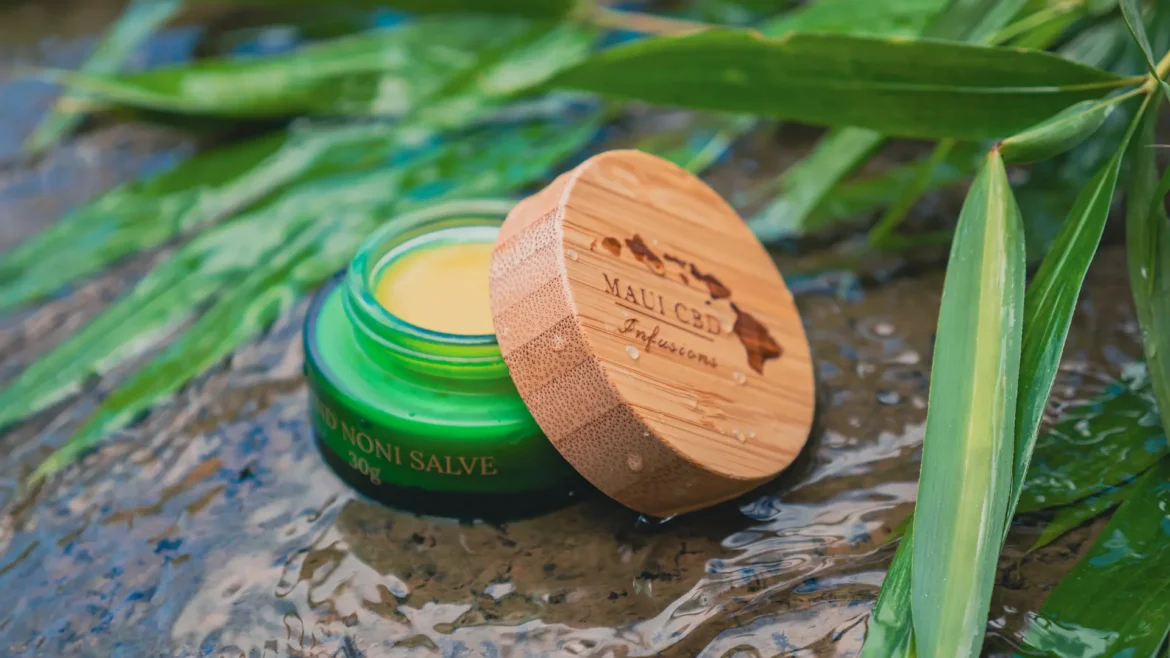
- Noni leaf appears most directly in the Island Noni Salve, which combines noni with full-spectrum hemp CBD, and in the Aloha Body Butter, which blends noni with aloe vera, avocado oil, and cocoa butter
This is a real-world example of the leaf-based, hand-harvested category of noni skincare discussed earlier, distinct from the fruit-extract noni found in many mass-market products.
How Do You Safely Use a Noni Topical?
Noni topicals are generally well tolerated, but that doesn’t mean you should skip the basics. A few simple precautions go a long way toward a safe first experience.
- Patch test first. Apply a small amount to your inner wrist or elbow and wait 24 to 48 hours before using it more broadly, particularly if you have sensitive skin or plant allergies.
- Apply to clean, dry skin. This lets the formulation absorb properly.
- Use a small amount. More product doesn’t mean a stronger effect, so follow the product’s directions.
- Avoid broken or compromised skin. Topical botanicals are generally intended for intact skin only.
- Stop use if irritation occurs. Redness, itching, or discomfort is a signal to discontinue and speak with a healthcare provider if it persists.
If you’re pregnant, nursing, or have a known plant or tree nut allergy, check with a physician before adding any new topical botanical, noni included, to your routine.
The Bottom Line
Noni leaf is a genuinely interesting Hawaiian botanical with more topical research behind it than most people realize, including small human trials most noni content never mentions. But that evidence is specific: it applies to certain extract types under certain study conditions, and it stops well short of treating skin conditions, reversing aging, or replacing sunscreen. Understanding noni by plant part, extraction method, and evidence type is the difference between an informed skincare choice and a marketing claim taken at face value.
If you’re curious to see what leaf-based, hand-harvested noni looks like in an actual formulation, the Island Noni Salve is a straightforward place to start.
Browse the full list of Hawaiian botanicals Maui CBD Infusions sources for its topicals.
Frequently Asked Questions
They come from the same plant, Morinda citrifolia, but are used and studied differently. Noni fruit is mostly consumed as juice and researched for internal health; noni leaf has a separate body of research focused more specifically on topical, skin-related use, including small human trials.
There's some supporting evidence, mainly antioxidant and anti-inflammatory activity in lab and animal studies, plus small human trials on skin tolerance and UV-related redness. It hasn't been shown to treat or cure any skin condition.
Human patch-test research found no allergic reactions among volunteers tested, a reasonable safety signal. Even so, individual reactions vary, so patch testing before regular use is recommended, especially for sensitive or reactive skin.
"Noni extract" can mean fruit juice, leaf extract, oil infusion, hydrosol, or powder, depending on how it was prepared. These forms are chemically different, so research on one type doesn't automatically apply to another.
A 2009 clinical trial found noni leaf extract reduced UV-induced redness in treated skin. This is preliminary and shouldn't be treated as sunscreen or a treatment for irritation from other causes.
Yes, and some brands formulate them together, but there's no dedicated research testing the combination specifically. Each ingredient has separate supporting evidence; the pairing itself hasn't been clinically studied.
Available safety research is reassuring but limited in scope. Since individual sensitivity varies, patch testing is recommended for all skin types, particularly for anyone with known plant allergies.
Most often in salves, oil infusions, body butters, and occasionally hydrosol mists. Leaf-based noni tends to appear in small-batch, regional formulations, while fruit-based noni is more common in mass-market products.